Utah Outdoor Activities

Resource To The Utah Outdoors


Home - Sitemap - Privacy - Contact Us - Advertising - Sponsors - Shopping

Outdoor Activities

Utah Campgrounds

Places To See

Utah Photo Galleries

Hotel Reservations

Utah RV Parks

Utah Recreational Property

Guides & Outfitters

Pheasant / Hunting Clubs

ATV Dealers / Rentals

Boat Dealers / Rentals

RV Dealers / Rentals

Resources

Message Board

Shopping


Canyonlands National Park


Canyonlands National Park

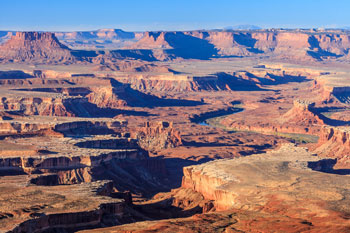
View from the Green River Overlook  (NPS Photo by Neal Herbert)

     Canyonlands National Park preserves a colorful landscape of sedimentary sandstones eroded into countless canyons, mesas and buttes by the Colorado River and its tributaries. Located in southeast Utah, the park sits in the heart of a vast basin bordered by sheer cliffs of Wingate Sandstone.

     The Colorado and Green rivers divide the park into four districts: the Island in the Sky, the Needles, the Maze and the rivers themselves. While the districts share a primitive desert atmosphere, each retains its own character and offers different opportunities for exploration and the study of natural and cultural history.

     Most visits to Canyonlands involve camping along the trails, roads and rivers found here. The four districts are not directly linked by any roads, so travel between them requires two to six hours by car. Generally, people find it impractical to visit more than one or two districts in a single trip.

History Of The Park

     People have visited what is now Canyonlands National Park for over 10,000 years. Over time, various groups moved in and out of the area in concert with the availability of natural resources and the technology for exploiting those resources.

Hunter-Gatherers

     Humans first visited Canyonlands over 10,000 years ago. Nomadic groups of hunter-gatherers roamed throughout the southwest from 8,000 B.C. to 500 BC Living off the land, these people depended on the availability of wild plants and animals for their survival. They do not appear to have stayed in any one area for very long. They left little in the way of artifacts and did not build homes or other lasting structures. However, the hunter-gatherers during this time created a great deal of intriguing rock art. Some of the best examples of their art, known as “Barrier Canyon Style,” remain on the cliff walls of Horseshoe Canyon.

Ancestral Puebloans & Fremont

     Roughly two thousand years ago, the hunter-gatherers began to rely more on domesticated animals and plants for food. These early farmers are called the ancestral Puebloan (formerly known as Anasazi) and Fremont people. They grew maize, beans and squash, and kept dogs and turkeys. In order to tend their crops, they lived year-round in villages like those preserved at Mesa Verde National Park. Though the two groups overlapped, the Fremont lived mostly in central Utah, while the ancestral Puebloans occupied the Four Corners region. These cultures can be distinguished by their different tools, pottery and rock art.

     Over time, growing populations at Mesa Verde caused a search for suitable land all over southeast Utah’s canyon country. By A.D. 1200, large groups had moved into the Needles District, especially in Salt Creek Canyon. However, granaries and dwellings used by the ancestral Puebloans are scattered throughout the park. Examples of these structures can be seen at Roadside Ruin in the Needles, Aztec Butte on the Island in the Sky and along many backcountry trails.

     For many years, changing weather patterns made growing crops more and more difficult. Around A.D. 1300, the ancestral Puebloans left the area and migrated south. Their descendants include the people living in modern pueblos in New Mexico and Arizona like Acoma, Zuni, and the Hopi Mesas.

Utes, Navajos and Paiutes

     Before the ancestral Puebloans left, other groups appeared in the area. The Ute and Paiute cultures may have arrived as early as A.D. 800. The Navajo arrived from the north sometime after A.D. 1300. All three groups still live here today. These cultures initially lived more of a hunter-gatherer lifestyle than the ancestral Puebloans. Their use and exploration of the Canyonlands area appears to have been minimal.

European Exploration

     For early European explorers, Canyonlands offered more of an impediment to travel than a destination. In the 1770s, the Spanish priests Escalante and Dominguez circled the area, looking for a route between New Mexico and California. Escalante and Dominguez failed, but trappers and traders from Taos and Santa Fe succeeded. In the early 1800s, the “Old Spanish Trail” became a well-worn route that passed through Moab like the highway does today.

     The first Europeans to explore Canyonlands were probably American and French trappers searching western rivers for beaver and otter. Pelts from these animals were in great demand in the east. One such trapper named Denis Julien carved his name, the date and a picture of a boat along the Green River in 1836. Julien also carved his name in Cataract Canyon and in Arches National Park.

     Official exploration of the Colorado and Green rivers did not occur until 1869, when Major John Wesley Powell led a group from Green River, Wyoming all the way through the Grand Canyon in Arizona. During the three month expedition, Powell mapped the rivers and recorded information about the natural and cultural history of the area. One stop of his in what is now Canyonlands inspired the following passage in his journal:

     “…The landscape everywhere, away from the river, is of rock – cliffs of rock; plateaus of rock; terraces of rock; crags of rock – ten thousand strangely carved forms.”

     Powell repeated the trip a few years later.

Settlement

     European settlements in southeast Utah developed from the missionary efforts of the Mormon Church. In 1855, Mormons set up a mission in what is now Moab, but conflicts with the Utes caused them to abandon it. The Hole in the Rock expedition–a Mormon mission charged with settling southeast Utah–founded the town of Bluff in 1880. The towns of Blanding, Moab and Monticello were settled shortly thereafter. Most residents made their living as farmers, prospectors or ranchers.

Ranching

     From the 1880s to 1975, local ranches used much of Canyonlands for winter pasture. Cowboys searched the canyons for good feed and water. They constructed trails to move their stock across the rugged terrain. To guard their herds, cowboys lived in primitive camps for weeks at a time. The Cave Spring Trail in the Needles District features one such camp.

     Places throughout the park bear the names of early cowboys. The Taylor, Holeman and Shafer families grazed cattle and sheep in what is now the Island in the Sky. Don Cooper, Mel Turner, D.L. Goudelock and Joe Titus ranched the Indian Creek area. Their holdings under the Indian Creek Cattle Company were bought by the Scorup and Sommerville families in 1914. Headquartered at the Dugout Ranch outside the Needles District, the Indian Creek Cattle Company operates today under ownership of the Nature Conservancy.

     The Biddlecome, Ekker, Tidwell and Chaffin families wintered animals in the Maze. The Ekker Ranch grazed cows on lands adjacent to the Maze until 2000. In addition to cattle and sheep, the rugged country around the Maze harbored outlaws. Robbers Roost, a mesa top west of the Maze, provided refuge for Robert Leroy Parker (a.k.a. Butch Cassidy), Tom and Bill McCarty, Matt Warner and others.

Mining

     The growth of America’s nuclear arms program in the 1950s created a high demand for uranium. Geologists thought that Utah’s canyon country contained a significant amount of uranium, but the rugged terrain made access difficult. To encourage prospectors, the Atomic Energy Commission offered monetary incentives and built almost 1,000 miles of road in southeast Utah. In Canyonlands, these roads include the popular White Rim Road at the Island in the Sky.

     Though the region produced substantial amounts of uranium, miners discovered very little in what is now Canyonlands. However, the newly created roads led to other discoveries. For the first time, much of Canyonlands could be seen from a car. Tourism slowly increased as more people learned about the area’s geologic wonders. By opening canyon county to travel, the miners blazed the trail for the creation of a National Park.

Creating a Park

     In the 1950s and early 1960s, Arches National Monument Superintendent Bates Wilson advocated the creation of a National Park in what is now Canyonlands. Wilson led government officials on jeep tours which featured lengthy talks over campfires and hearty Dutch oven dinners. Secretary of the Interior Stewart Udall joined one of these tours in 1961, and began lobbying for the proposed park. On September 12, 1964, President Lyndon B. Johnson signed Public Law 88-590 establishing Canyonlands National Park. Initially consisting of 257,640 acres, Congress expanded Canyonlands to its present size of 337,598 acres in 1971.

     Activities in park include auto touring, 4 wheel drive trails, hiking, camping, boating, horseback riding and more.

Click Here for information on campgrounds in the park.

Click Here for more information on the Canyonlands National Park.


Click Here for hotel reservations in Moab UT, just 26 miles from Canyon Lands National Park.


Copyright 2006 Utah Outdoor Activities All Rights Reserved

Home - Site Map - Contact Us - Privacy Policy