This article may include affiliate links. If you click a link and make a purchase, Utah Outdoor Activities may receive a small commission at no extra cost to you. We only recommend products or services we personally use. FTC Affiliate Disclosure.
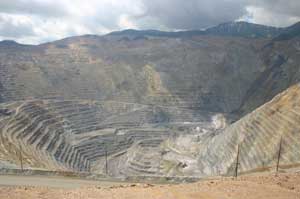
The Visitor Experience at Bingham Canyon Mine is set to officially re-open on Monday, April 1, 2019, more than six years after it was forced to close due to a 160-million-ton landslide.
Bingham Canyons history begins back in 1848 when it was first settled by two brothers, Thomas and Sanford Bingham. The brothers thought it was a great place to quietly raise cattle and cut timber. But the rich deposits of metals, and the later coming of the railroads, dramatically changed the future of the canyon.
In 1863, Colonel Patrick Conner sent soldiers of the Third California Infantry, stationed at Fort Douglas on Salt Lake City's eastern foothills, to the Oquirrhs. His soldiers, many of them ex-miners, are credited with discovering the mineral wealth of Bingham Canyon, and Conner with organizing the area as a mining district.
Before 1869, fewer than 100 miners, mostly Irish, Welsh, Cornish, and Anglo-Americans, lived in crude cabins and dugouts along the canyon walls. By 1870, the population in the canyon had more than doubled, to 276. In 1871, Bingham Canyon's population was large enough to be organized as a voting precinct of Salt Lake County.
News of the mineral rich Bingham Canyon reached the world in 1873 and beckoned immigrant miners. An underground mining boom was on! The town of Bingham Canyon was incorporated in 1904. That was the same year the Bingham Merc, the canyon's greatest community landmark, opened. The Merc became the central point of the canyon and it flourished until it closed in 1956.
With the introduction of large-scale, open-pit mining methods in 1906, immigrants from all over the globe came to Bingham Canyon to seek their fortunes and find the "American Dream". By 1912, Bingham's population was 65 percent foreign-born. In 1914 the population had grown to 10,000. At their peak, the towns of Bingham Canyon, Copperfield, Highland Boy and numerous smaller mine camps had between 15,000 and 20,000 residents. In 1927, the Utah Copper Company started to build a planned residential community called Copperton at the mouth of Bingham Canyon. Today only two of the original towns exist, Copperton and Magna.
The Bingham Canyons Mine Visitor Center:
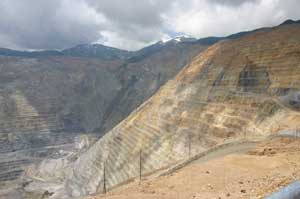
Standing about 6700 feet above sea level, at the mine overlook within the Bingham Canyon Mine, you can see, hear and feel the breathtaking and awesome magnitude of the largest man-made excavation on earth. More than three quarters of a mile deep and 2 1/2 miles wide, this mine, which is on the National Register of Historic Sites, is just one of the two man-made objects on earth that can be seen by astronauts from outer space. The other is the Great Wall Of China.
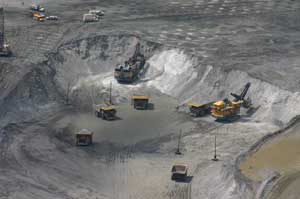
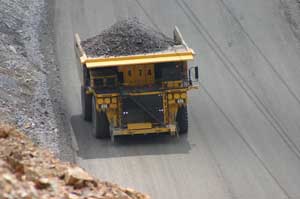
From the overlook visitors can watch 255-to-360-ton capacity haulage trucks deliver copper ore to the in-pit crusher, where the material is reduced to the size of a soccer balls before being loaded onto a five-mile conveyor that carries the ore to the Copperton Concentrator. More than six billion tons of material have been mined to produce more than 16 million tons of copper metal since surface mining operations began in 1906. In addition, vast quantities of by-product gold, silver and molybdenum have also been produced from this mine.
By visiting the modern visitors center you can view displays of artifacts and learn the history of this world famous mine. You can also watch a 16 minute video presentation that takes you into other Kennecott Utah Copper plant facilities to follow the production of copper from low grade ore in the mine, to 99.99 percent pure copper in the refinery.
Pricing:
Tickets are $5 each and children under the age of five are free. All proceeds will be generously donated to the Kennecott Charitable Foundation, a Utah-based charitable organization committed to positively impacting the community since its inception in 1992.
More Information:
Bingham Canyon Lark Parking Area
2732 Bacchus Hwy
Herriman, UT 84096
We hope you enjoyed this information. For more outdoor activities, please connect with us on YouTube, Facebook and Instagram. Help us keep this site up and running by visiting our online store which features outdoor themed gifts, decor and more. Thank you for visiting and for your ongoing support!