This article may include affiliate links. If you click a link and make a purchase, Utah Outdoor Activities may receive a small commission at no extra cost to you. We only recommend products or services we personally use. FTC Affiliate Disclosure.
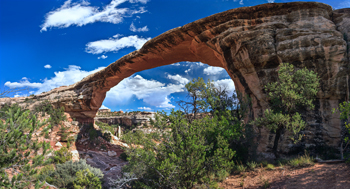
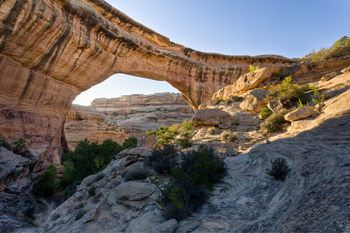
Natural Bridges protects some of the finest examples of ancient stone architecture in the southwest. The monument is located in southeast Utah on a pinyon-juniper covered mesa bisected by deep canyons of Permian age Cedar Mesa Sandstone. Where meandering streams cut through the canyon walls, three natural bridges formed: Kachina, Owachomo and Sipapu. At an elevation of 6,500 feet above sea level, the Monument is home to a wide variety of plants and animals.
Several names have been applied to the bridges. First named "President," "Senator" and "Congressman" by Cass Hite, the bridges were renamed "Augusta," "Caroline" and "Edwin" by later explorer groups. As the park was expanded to protect nearby Puebloan structures, the General Land Office assigned the Hopi names "Sipapu," "Kachina" and "Owachomo" in 1909. Sipapu means "the place of emergence," an entryway by which the Hopi believe their ancestors came into this world. Kachina is named for rock art on the bridge that resembles symbols commonly used on kachina dolls. Owachomo means "rock mound," a feature atop the bridge's east abutment.
Activities in the park include camping, auto touring and hiking. Most visitors spend at least two to three hours exploring Natural Bridges. Plan on stopping at the visitor center and touring the scenic drive, with stops at each overlook to view the bridges. Several short hikes allow closer inspection of these remarkable formations, as well as Horsecollar Ruin.
The 8.6-mile loop trail provides visitors with more time the opportunity to experience the beauty of White Canyon while hiking to all three bridges.
More Information:
Natural Bridges
HC-60 Box 1
Lake Powell, Utah 84533
Additional Information:
https://www.nps.gov/nabr/index.htm
We hope you enjoyed this information. For more outdoor activities, please connect with us on YouTube, Facebook and Instagram. Help us keep this site up and running by visiting our online store which features outdoor themed gifts, decor and more. Thank you for visiting and for your ongoing support!